A 3 Bet is the term used in poker to describe a specific re raise. A 3 bet is typically made before the flop but can also be performed post flop. It is the third bet on a specific round. Check out examples below. This poker video defines and shows an example of what a 3Bet is on PokerStars. In Hold'em, the blinds are considered the first bet, the raise is the second b.
Why Light 3-Betting Works. Light three-betting is one of the first intermediate Texas Hold'em moves you should add to your poker skill set because it helps counteract a common problem you'll find in most Hold'em game: aggressive opponents. The following table shows my power rating for each initial 2-card hand in a 3-player game. The numbers are on a 0 to 40 scale. Use the top table if you have a pair, the middle table if your cards are suited, and the bottom table if your cards are unsuited. A 3-bet is when there has been a raise and then another raise after that. Simple enough, but let me give you one quick example to drive it home: After the SB and BB post the $1 and $2 blinds, lets say there is a raise to $8 from a player in MP. If another player in LP raises it again to $24, this is called a 3-bet.
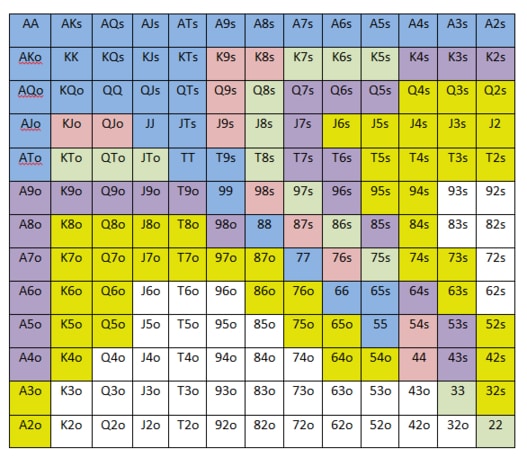
The main objective of 3 Bet Bluffing in Texas Hold'em is to take down the pot pre-flop. Many players don’t recognise what hands they should 3 Bet for value and what should 3 Bet to to bluff. Some players are simply ‘clicking buttons’ and do not have a solid preconceived plan to follow.
Benefits of 3 Bet Bluffing are:
1) Boosting our Win Rate
2) Creating an Aggresive Image
3) It's low variance due to the fact we don’t have to c-bet and play postflop when our opponents fold.
Who should be target for the 3 Bet Bluff?
1) an opponent who folds to 3bets often. stats wise f3b 70%+
2) an opponent who attempts to steal often(Button opening of 40%+)
What position to 3 Bet Bluff in?
Hands to 3 Bet Bluff with
1) Bet the top of your range with hands that are not strong enough to call with. Hands such as AxS, KxS, suited 1 gappers (97s, 68s), suited 2 gappers (710s), Small pocket pairs (if you can’t set mine profitably).
Hands not to do it with
2) We shouldn't use this play with hands we can dominate our opponents range with. KQos for example. If they fold to the 3bet then we miss out on potential post flop value.
Positional Awareness:
1) Our 3bet will be interpreted as stronger or weaker depending on the positions involved.
2) Blind vs. Blind battles. We may get played back at more from these positions.
3) 3bets look much stronger MP vs EP than BB vs BTN
I am ready to take my poker game to the next level!
Pay attention of:
Who we are 3betting - For example If a fish folds to 3bets a lot from CO but not EP then we should not be bluffing vs his EP open a lot. However vs a reg we can do it as we get more credit for our 3bets.
Bet Sizing for 3 Bet Bluffs:
Should be somewhere between 2.8x and 3.5x the original raise. This will allow us to get most respect but to lose the least if 4Bet.
Squeeze sizing from blinds should be around 12bbs vs 2 players.
How often does our 3bet bluff need to work?
Texas Holdem 3 Bet Range
SB raises to 3bb, hero BTN raises 9bb, Risking 8bb more to win the 4bb pot. Total pot = 12bb. Hero invests 8bb/12bb which is 66.66% so we need to win the pot this amount of the time to break even in the long run. Anything above this is profit. If the villain has a f3b 67%+ then heros play is +EV in the long run.
Final Pointers:
1) Don’t go crazy - Players will play back at us.
2) Our play works more if we have a tight table image.
3) Don’t do it all the time until it stops working. Be smart and constantly adjust to your opponent.
The Three Bet
One of the common definitions you will hear as you play poker is “3-bet”, or “three-bet”. A 3-bet as most players use the term means the act of putting in the third bet, technically the second “raise”, the “3-bet” during any given round of action. It’s only in recent years that the term has become popular, indicative of its use during online play.
For flop games, such as hold’em and Omaha, the pre-flop 3-bet is technically different than the post-flop 3-bet. In these poker games blinds are used, and the act of posting the small and big blinds is considered the first “bet”. Subsequent players, beginning with the “under the gun” (UTG) player to the big blind’s immediate left, have the option of calling that first bet (the amount of the big blind), or folding or raising. In a typical game, the first pre-flop raise is technically a “two-bet”, but you’ll never hear it called that. Instead, it’s when another play makes a second raise, going over the top of the first raiser, that the “three-bet” term is used. Below is a visual of what a pre-flop 3-bet looks like.
In post-flop play, the 3-bet consists of an initial bet, a raise, and then a re-raise (perhaps by the initial bettor). Since the initial bet itself can be sizable, the post-flop 3-bet is proportionately larger in most instances than its pre-flop counterpart. In cash games and in the late stages of tourneys, 3-bets often involve all-in moves by one or more players, though you’re just as likely to hear the words “pushing” or “jamming” (moving one’s entire stack into the middle) in those instances.
What Does a 3-Bet Mean?
A 3-bet, which is always a form of a re-raise is designed to be an indicator of a true premium hand. The 3-bet is a shot over the bow of the initial raiser, designed to capture that pot right there. The intent of the 3-bet is to say to the initial bettor, “Yeah, you may have a good hand, but I’ve got a better one.” One common variation involves the initial raise coming from a late position, the button player or the cut-off (to the button’s immediate right), and the 3-bet is made by the small or big blind, who may assume the button or cutoff is attempting to steal the blinds. Overall, the 3-bet is traditionally one of the strongest moves a player can make, trailing perhaps only the all-in push and the check-raise in its ability to change a hand. It’s supposed to mean that the player making the move has a very strong hand, though this being poker, that is not always the case.
Making Your Own 3-Bets
The use of 3-bets is best done selectively, at opportune moments. Many hyper-aggressive players 3-bet with a wide range of hands, including many garbage hands, in the nature of bluffs. Most 3-bets, however, are done with big hands.
When to 3-bet a hand and when to just call (called a “smooth call” or “smoothing”) is one of the trickiest lessons players must learn. Knowing your opponents’ tendencies is vital to success, because the best poker players play their opponents as much as their own hands. A 3-bet works best against fairly loose players, some of whom are described as “calling stations”, who simply cannot fold marginal holdings when prompted. Another successful type of 3-bet can be done against a player who might over-value the long-term prospects of the game or tourney in deference to what might happen in that specific hand. He might be surrendering a bit too much of his chance to win in hopes of getting a better opportunity in a later hand.
Then there are bluffs. The bluff type of 3-bet is called a “re-steal”, and properly executed, it can be one of the most profitable moves in a player’s arsenal. However, like any good play, using it too much is one of the quickest ways to go broke. Other players will eventually react to a player that is putting in too many 3-bets, and sooner or later, the player putting in those over-the-top bets will be “looked up” (called) by his opponent. However, if you’re a steady, conservative player, 3-betting an aggressive foe will work more often than you might believe. Those players are trying to steadily make small gains against your perceived, relative passivity, and when you fight back they’ll often go try another door.
Defending Against the 3-Bet
Texas Hold'em 3 Bet
Defending against the 3-bet boils down to understanding both your opponents and the circumstances of the game. Against a tight opponent who plays few hands, a 3-bet invariably means a monster and you can ditch all but the largest hands against this opponent. Even if he’s on a rare bluff, his natural tendencies against bluffing should serve as a warning.
Texas Holdem 3 Bet
Aggressive, late-position players will often three-bet with holdings such as middle pairs, AK or AQ, and depending on your own hand, it’s often correct to play or even to put the 4-bet in and take your chances. Be aware that with position and with correct “pot odds” – referring to the relationship between the amount of money already in the pot and the total amount a player stands to win – a late-position player may be “priced in” to making his own call with more inferior hands than you might hope.
Author:Joseph Falchetti (twitter)
(C) Copyright PokerWebsites.com, 2018